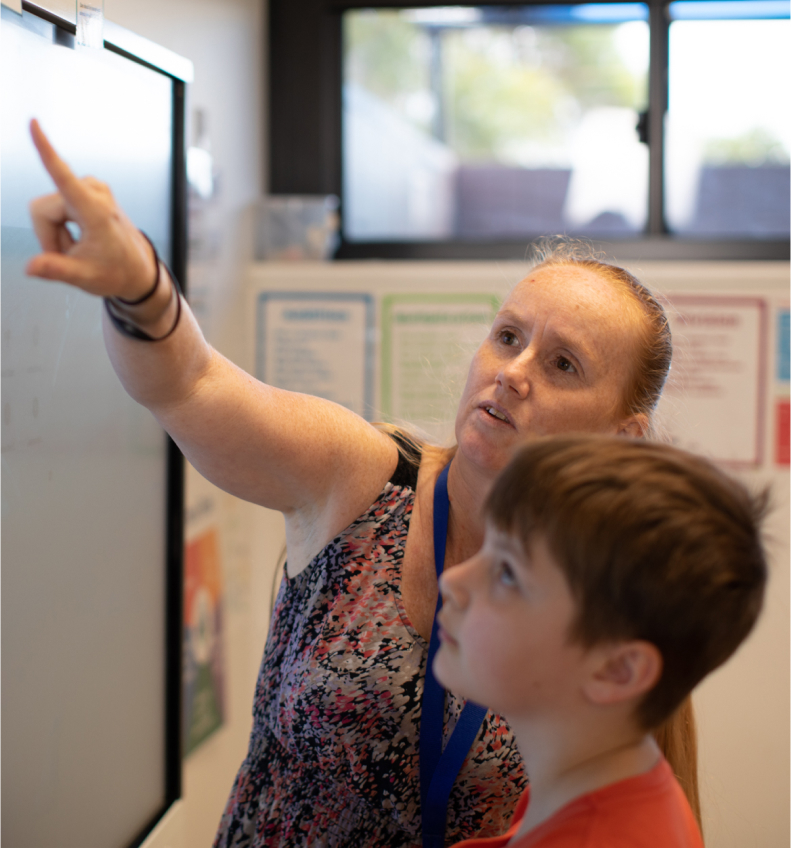

Autism Queensland (AQ) School is an accredited autism-specific independent special school providing small class learning, personalised education, and collaborative support for autistic students.
AQ School strives to provide our students with the best education possible in a supportive environment that meets their individual needs and fosters their preferences, aspirations, and goals. We are committed to nurturing students to be happy, healthy, successful, and productive by providing interdisciplinary support, personalised learning goals, and access to a functional and sequential curriculum.
Please note: AQ School students must have a diagnosis of Autism Spectrum Disorder (ASD). Year level and enrolment offerings, and vacancies vary by location. Fees apply for AQ School and waitlists may apply. NDIS funding cannot be used for AQ School fees.
Campus locations
AQ School operates campuses across South-East, Central, and North Queensland, alongside a Distance Education program for eligible students living in regional and remote communities throughout the state.
Please note: Our Education & Therapy Centres at Gladstone and Gold Coast do not comprise combination AQ School campuses, and our AQ School Brightwater campus does not comprise a combination Education & Therapy Centre.
Year level & enrolment offerings by campus
| Campus | Year levels | Enrolment offerings |
|---|---|---|
| Brighton (Brisbane North) |
Prep–Year 12 | Full-time & part-time* |
| Brightwater (Sunshine Coast) |
Prep–Year 10 | Full-time & part-time* |
| Cairns | Prep–Year 6 | Full-time & part-time* |
| Mackay | Prep–Year 3 | Full-time & part-time* |
| Rockhampton | Prep–Year 3 | Full-time & part-time* |
| Sunnybank Hills (Brisbane South) |
Prep–Year 12 | Full-time & part-time* |
| Distance Education | Year 3–Year 10 | Full-time only |
*What is part-time shared enrolment?
Enrolled students can attend an AQ School campus part-time in combination with shared enrolment at another accredited primary or high school (including accredited distance education providers if applicable). Part-time enrolments include either 2- or 3-day attendance options at AQ School (decision made on a case-by-case basis and is dependent on criteria which impact school attendance, engagement, and/or access to learning).
The part-time format is specifically designed to:
- Enable students to maintain a social connection with their peer group, local school community, and local school curriculum.
- Enable students to practice and develop skills for generalisation.
- Provide an opportunity for observation, data collection, and sharing of expertise among key stakeholders.

Our educational program
AQ School’s flexible and personalised educational program has been developed to support our diverse student population. Students are grouped in multi-aged classes with consideration given to the age, curriculum access levels, and individual adjustments required to ensure class dynamics are safe, functional, and offer continuous learning opportunities for all students.
Personalised learning plans build on each student’s strengths, interests, and needs, with collaborative input from students, families, and an interdisciplinary team. Through explicit teaching, structured and predictable environments, individualised wellbeing and regulation supports, and opportunities for student participation, the program promotes learning, independence, self-advocacy, and social development. Ongoing monitoring, attendance support, and transition planning help ensure each student’s education remains responsive to their changing needs.
Additionally, AQ School offers a specialist Senior Program and Distance Education program. Read more about these offerings below.
Our approach to learning
Our educational program’s individualised approach to learning includes:
- Personalised leaning: Development of personalised learning plans to support each student’s access to, participation in, and engagement with their education.
- Strengths-based planning: Tailored curriculum decisions that support access to the Australian Curriculum Learning Areas, building on each student’s strengths, interests, and learning needs.
- Collaborative planning: Consultation and collaboration with students, families, the AQ School interdisciplinary team, and other stakeholders, including shared enrolment school teams.
- Interdisciplinary support: Teachers, teacher aides, therapists, behaviour specialists, and wellbeing support facilitators work together to provide universal, targeted, and specialist supports.
- Structured learning environments: Clear, positive, and predictable classroom and playground environments, supported by AQ School Universal Supports.
- Explicit teaching: Targeted teaching to support wellbeing, relationships, and regulation, alongside the Australian Curriculum’s personal and social capabilities to develop independence, self-advocacy, social awareness, and social management.
- Student participation: Opportunities for students to contribute to goal setting and decisions about the supports that help them learn and participate.
- Wellbeing and regulation: Regular check-ins, individualised regulation supports, and access to campus wellbeing and behaviour support facilitators.
- Attendance and engagement: Monitoring and support to promote consistent attendance, participation, and engagement in learning.
- Transition support: Planning and support to help students navigate transitions between activities, settings, year levels, and educational pathways.
- Ongoing review: Regular monitoring of student progress and review of personalised plans to ensure supports remain relevant and responsive to changing needs.
Our Curriculum
AQ School is an accredited independent special school delivering the Australian Curriculum. Students access either the Foundation (Prep) to Year 10 curriculum or the Queensland Certificate of Individual Achievement (QCIA) curriculum, with curriculum access prioritised as MUST, SHOULD and COULD. This framework guides personalised curriculum decision-making and supports a functional, continuous educational program for students requiring extensive or substantial educational adjustments, as identified through the Nationally Consistent Collection of Data (NCCD) on School Students with Disability.
Curriculum decisions for classes and individual students consider:
- Learning history: Students’ access to and progress through learning area content throughout the year and across year levels.
- Attendance: The number of days students attend AQ School, including part-time or full-time attendance and transitions into or out of the school.
- Individual needs: Personalised wellbeing, safety, and health needs that may affect students’ access to and engagement with the curriculum each semester.
All students accessing the Foundation (Prep) to Year 10 curriculum have opportunities to participate in small-class learning within the English, Mathematics and Health and Physical Education (HPE) learning areas. Access to other learning areas is considered and provided according to students’ individual learning needs and priorities.
Our interdisciplinary team
AQ School’s interdisciplinary team approach to assessment, planning, teaching, and reporting involves teachers, teacher aides, speech pathologists, occupational therapists, wellbeing facilitators, and behaviour support facilitators. This team works to provide evidence-informed supports for all students:
- Environmental supports: Staff and student relationships, the classroom, and playground environment (including sensory considerations).
- Social & emotional supports: Regulation support, self-advocacy, social participation.
- Instructional supports: Structured teaching, multiple means of engagement, representation, action and expression, and language accessibility.
- Behavioural supports: School values and expectations, active supervision, enabling safe behaviours, and responding to unsafe behaviours.
- Individual supports: Personalised learning planning, individual adjustments, collaborative goal setting, and transition planning.
Our Senior School Program
AQ School’s Senior Program for full-time students in Years 10-12 aims to support those students who have chosen a Queensland Certificate of Individual Achievement (QCIA) pathway, which allows them to access a personalised program with autism-specific adjustments and supports. This program also supports students develop positive peer friendships, confidence, success, and allows strengths-based learning.
Personalised QCIA curriculum planning is developed by key stakeholders and approved by the Queensland Curriculum & Assessment Authority (QCAA) within the 5 curriculum organiser categories:
- Communication & technologies
- Community, citizenship, & the environment
- Leisure & recreation
- Personal & living dimensions
- Vocational & transition activities.
Curriculum planning and delivery are informed by evidence-based strategies and resources that support personalised learning, engagement and future pathways. These include the AQ award-winning Adolescent/Adult Goal Setting Tool (AAGST), support to develop or review Senior Education and Training (SET) plans, consistent learning relationships and environments, and the integration of students’ strengths and interests into learning. Students are also supported through myWAY Employability resources, with supported work experience opportunities identified for senior students to build skills and explore pathways to employment.

AQ School Distance Education
Distance Education is an enrolment option offered by AQ School for students who meet Student With Disability (SWD) eligibility criteria and, due to regional location, are unable to attend an AQ School campus. Distance Education provides students with the opportunity to learn from home by interacting daily with the interdisciplinary AQ School team remotely, with technology playing a large role in allowing this program to take place.
AQ School Distance Education is delivered out of our host campus, Sunnybank Hills, and currently offered to students in Years 3-10.
Please note: Enrolment priority is given to students from remote and regional areas as we aim to provide specialist schooling options for students across Queensland in these disadvantaged communities. Fees apply for AQ School Distance Education and waitlists may apply. NDIS funding cannot be used for fees.
Distance Education approach to learning
AQ School Distance Education students engage in core Australian Curriculum Learning Areas, including English, Mathematics, and Health and Physical Education. Additional subjects, such as Science, The Arts, and Humanities and Social Sciences (HASS), are incorporated into personalised programs, schedules, and interactive digital workbooks to reflect each student’s learning needs and engagement levels.
The AQ School interdisciplinary team provides curriculum content, instruction, and resources through online platforms accessed by students and their home supervisors. Each student has a personalised learning plan, developed collaboratively with the student, their family, and the AQ School team. The plan outlines individual learning goals, strategies, and adjustments to support successful participation.
Benefits of Distance Education offered by AQ School include:
- Flexible learning without the need to physically attend an AQ School campus.
- Daily and weekly schedules tailored to each student’s individual needs.
- Real-time instruction and feedback from the interdisciplinary team.
- Opportunities to interact with classmates through online learning environments established by the interdisciplinary team.
- Flexible access to learning materials, allowing students to revisit content and practise skills at their own pace and as often as needed.
- Opportunities to demonstrate knowledge and independent skills through the development and sharing of an online personal portfolio.
- Reduced barriers associated with attending a mainstream school.
- Flexibility to continue accessing support from personal therapists alongside daily and weekly learning activities.
Attendance in AQ School’s Distance Education program is measured through students’ regular engagement with their learning program and the ongoing sharing of completed work, reflecting each student’s individual abilities and level of independence.
Important considerations for Distance Education
While AQ School’s Distance Education program offers many benefits, it also presents potential challenges. To help families determine whether the program is suitable for their child, it is important to consider the following questions:
- Learning environment: Where at home can a positive learning environment be established, and what resources or equipment will be needed?
- Home supervision: Who will take on the ongoing role of home supervisor, and how much time can they commit to supporting the student’s learning?
- Student readiness: What skills has the student developed to support their participation and engagement in Distance Education?
- Family routines: What changes or adjustments to the family’s daily and weekly routines will be needed to accommodate learning from home?
Enquiry & enrolment process
Parents, carers, and legal guardians are welcome to submit an initial enquiry with our Client Services & Support team via our online enquiry form, emailing [email protected], or calling the AQ Helpline.
Please note: An expression of interest does not guarantee an enrolment offer. Each application is processed and considered in accordance with the AQ School educational program, resources available, confirmed vacancies, and the applicant’s individual educational and support needs. The final decision is made by the AQ School Principal and no negotiations will be entered into.
What to expect during the enrolment process?
- After our we receive your initial enquiry, a consultant from our Client Services & Support team will contact you to arrange an initial consultation. During this consultation we will provide you with all the information you should know about AQ School and discuss your child and family’s needs.
- After this consultation you may be directed to fill out an official expression of interest (EOI) form and to provide a number of supporting documents. These may include (but not limited to): diagnosis letters, medical action plans, therapy or medical reports, school reports, learning and transition plans, parent agreements or court orders (where applicable), birth certificates and/or other forms of identification.
- An administration fee ($200*) is payable when you submit your formal EOI.
- EOIs are reviewed by the AQ School team and you will be contacted with the outcome. Waitlists may apply.
- When a vacancy becomes available, you will be contacted for an interview and campus visit (this will be organised before formal enrolment placement is offered).
- A refundable deposit ($1,000*) is required upon acceptance of a formal enrolment offer. This deposit is refunded at the end of the student’s enrolment (except in the event of non-payment of school fees and/or insufficient notice to end of enrolment).
*Please note: All fees are subject to change without notice. Please contact us for all up to date information regarding school fees and enrolment information.
Criteria for ongoing enrolment
While ongoing enrolment at AQ School may benefit a student and their family, the safety and wellbeing of all students and staff remains paramount. These considerations take precedence over the benefits of enrolment and may mean AQ School cannot always accommodate a family’s requests or preferences.
This may apply where enrolment or continued enrolment significantly impacts the safety of the student, other students or staff, or where providing reasonable educational adjustments would result in unjustifiable hardship for AQ School. We may terminate enrolment at any time where:
- A student is, or becomes, unable to participate in small group settings.
- A student demonstrates unsafe behaviour towards themself and/or others.
- A student is unable to participate or engage with learning without the need for ongoing one-to-one support.
- A student’s continued enrolment at AQ School poses an unacceptable health or safety risk to staff, students, parents and/or themselves (this includes, without limitation, where a parent’s actions may pose a health and safety risk).
- A parent breaches the terms of AQ School’s Enrolment Agreement or any of AQ’s policies and procedures.
- Failure to act on any financial notices issued by AQ regarding outstanding school fees.
Should these criteria not be met, a meeting will be arranged at the earliest opportunity to discuss options and consider alternative arrangements to better meet the educational needs the student and/or the family’s circumstances, and confirmed in writing.
While AQ School will use its best endeavours to achieve agreed student goals and desired outcomes, it does not warrant or guarantee that any particular result or outcome sought by a student and/or their family will be achieved.
Please note: Terms, conditions, and policies are in place for AQ School, enrolments, cancellations, and fees.
School fees
AQ School enrolments are subsidised by Australian Government and Queensland Government funding; however, school fees still apply and are invoiced at the beginning of each school term. Termly fees remain payable for the duration of a student’s enrolment and are not refunded for periods of non-attendance, including illness, holidays, and transition periods.
Please note: NDIS funding cannot be used for AQ School-related purposes, including payment of AQ School fees and enrolment deposits.
Financial assistance & financial hardship:
- Discounts are available for families who pay their fees before the due date.
- Families can access flexible payment options through AQ’s partnership with Edstart (read more below).
- Fee relief and concessions may be available to eligible families. These are not guaranteed and assessed on a case-by-case basis. No negotiations will be entered into.
- The AQ Foundation awards annual bursaries to support families experiencing financial hardship where school fees are a barrier to enrolling or continuing enrolment at AQ School. These bursaries are funded through community, corporate, and philanthropic donations (read more below).
Optional EDSTART Payment Plans
AQ has partnered with Edstart to make managing school fees easier for families. School fees play an important role in supporting AQ School’s ongoing sustainability and the quality of education we provide. Partnering with Edstart gives families access to specialist support and flexible payment options, while allowing us to focus on student learning and wellbeing.
Edstart allows you to spread your school fees across weekly, fortnightly, or monthly instalments over 12 months, with no credit checks or transaction fees for families. You can choose your payment amount, method, and preferred payment day, and adjust your plan at any time. Families will continue to have the ability to pay termly through AQ School if they wish.
Download the Edstart flyer or read their FAQs here.
Benefits for families:
- Flexible payments: Choose weekly, fortnightly or monthly instalments to suit your budget.
- Convenient payments: Edstart pays your school fees to AQ in full each term, while you repay Edstart through your chosen payment plan.
- No extra costs: AQ covers all Edstart transaction fees, so there is no cost to families.
- Choice: Continue paying AQ School directly each term or annually if preferred.
How it works:
- Set up your account: Submit your details through the dedicated Edstart website.
- Finalise your plan: The Edstart team will contact you to complete your account set-up.
- Manage your payments: Edstart pays your school fees when your invoice is issued, and you make payments according to your chosen plan.
If your child is enrolled at AQ School and you would like to set up your payments through Edstart, please set up an account via the Edstart online portal, email: [email protected], or call 1300 139 445.
AQ Foundation Bursary
The AQ Foundation offers limited annual bursaries to help Queensland families experiencing financial hardship, where school fees are a barrier to enrolling or remaining enrolled at AQ School. Funded by community, corporate and philanthropic donations, bursaries help cover tuition fees for Prep to Year 12 students across all AQ School campuses, including Distance Education.
Families must meet eligibility criteria, with priority given to those most in need, including low-income families, families in regional and remote communities, and Aboriginal and Torres Strait Islander families.
How to apply: Applications open for a limited time each year, usually in the second half of the year. Dates may vary and are subject to change. This will be communicated with enrolled AQ School families and on the AQ website and social channels.